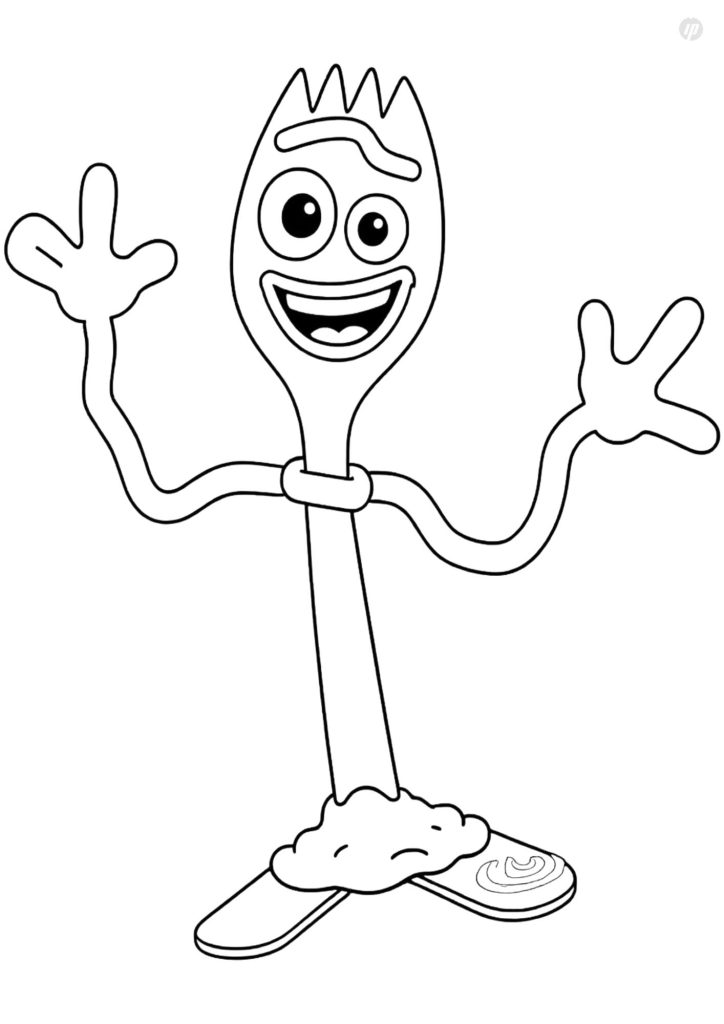
Forky has a question before the crayons even touch the page: how did a plastic spork become one of Bonnie’s most unforgettable toys? That question is part of what makes this Forky from Toy Story 5 coloring page so much fun. Kids can print the picture, study every handmade detail, and decide whether to follow Forky’s familiar colors or create a brand-new version that looks as though it came straight from Bonnie’s craft table.
Start with the shape that makes Forky easy to spot. His main body is a white plastic spork, with a rounded bowl and short fork points at the top. Instead of filling the whole body with a heavy layer of color, younger artists can leave most of it white and add a soft gray or pale blue line near the edges. This keeps the plastic look while helping the outline stand out. Older kids can try gentle shading under the rim or around the sides, pressing lightly so the center stays bright.
Forky’s face is where the picture can quickly turn silly, surprised, worried, or curious. His two googly eyes are different sizes, so they do not need to match perfectly. One pupil can look up while the other looks sideways. His red eyebrow can bend into a sharp V, and his blue mouth can curve in a completely different direction. Pink cheeks add two small pops of color. A second printed copy is useful here because kids can test two expressions without erasing the first one.
The red pipe cleaner arms offer another kind of coloring challenge. Rather than filling them as flat red shapes, kids can draw tiny curved lines along the arms to suggest the fuzzy, twisted texture. A regular crayon works well for the wider sections, while a sharpened colored pencil can reach narrow loops and bends. Children who enjoy pattern work can add darker red marks on one side and lighter red marks on the other, creating the look of light hitting the wire.
Kids who would rather paint can print the page on heavier paper and use a small brush with washable paint on the body, cheeks, or mouth. The paint should stay fairly dry so it does not soak through the sheet. Crayons and colored pencils are easier for fine details, but a little paint can give the larger sections a bold craft-project look.
Forky first appeared in Toy Story 4 as a craft project Bonnie made at kindergarten. Because he was created from items that had been treated like trash, he did not understand why everyone called him a toy. Woody took on the job of helping him see why being there for Bonnie mattered. That unusual beginning gives this coloring activity a built-in story idea: what might happen if an ordinary object on a classroom table suddenly became someone’s favorite toy?
Instead of drawing a large background right away, kids can build a small “craft clue” scene around Forky. A crayon stub, a paper star, a name tag, or a glue-stick cap can appear near his feet. These objects do not have to come from an official movie scene. They are simply clues showing where an invented version of Forky might have been made. This works especially well for children who enjoy storytelling but feel unsure about drawing full rooms or complicated scenery.
Another idea comes from Forky Asks a Question, the Pixar series in which he tries to understand topics such as love, time, and cheese. The series was released in 2019, directed by Bob Peterson, and includes ten short episodes. Kids can add a speech bubble beside the coloring page and write a question Forky might ask about something nearby, such as “Why do crayons get shorter?” or “Where do missing socks go?” The question should be the child’s own invention, not a line from a movie or short.
This activity can be adjusted for different ages without changing the picture. A six-year-old might color the mouth, cheeks, eyebrow, and arms, then leave the white body mostly untouched. A nine or ten-year-old may enjoy adding shadows, wood-grain lines on the craft-stick feet, tiny color bands on the rainbow sticker, or texture marks on the pipe cleaner. The same printable Forky coloring page can work for quick coloring time or a slower art project with more careful details.
The familiar color plan is only one option. Forky can keep his white body, red arms, blue mouth, and pink cheeks, or he can become a wild new craft creation. A space-themed Forky might have navy arms, silver cheeks, and tiny stars across his body. A school-spirit version could use two team colors. A candy version might have striped arms and bright dotted cheeks. These are imaginative designs rather than official costumes, so kids can change every color without worrying about getting the character “wrong.”
There is also a simple drawing game hidden inside the page. Ask the child to circle the parts that look manufactured, such as the plastic spork and googly eyes, then point to the parts that look handmade, such as the twisted arms and shaped mouth. After that, the child can draw one extra piece that Bonnie might add during an imaginary repair. It could be a paper patch, a sticker, a yarn bow, or a tiny cardboard badge. The added piece belongs to the child’s own story and is not meant to represent something shown in the movie.
In Toy Story 5, Forky is happy to be a toy and is paired with Karen Beverly, a plastic knife turned into a toy. Pixar’s official character description says the two are getting married, while Forky helps Karen understand what he has learned about toys, life, and trash. That gives older kids another drawing prompt: create a small wedding-card border around Forky using hearts, paper confetti, or colorful craft shapes, without trying to copy a scene from the movie.
For a classroom activity, each student can print the same Forky picture but follow a different prompt. One group may use the character’s familiar colors. Another can design a weather version with sunny, rainy, snowy, or windy patterns. A third group can invent a question for the speech bubble. When the pages are displayed together, children can compare how one simple outline led to many different results. The activity stays focused on drawing and coloring while giving students an easy way to explain their creative choices.
At home, the printable can become a quiet side-by-side project. One person colors Forky as he normally appears, while the other invents a completely new craft version. When both pages are finished, compare the eyes, mouth, arms, and small details instead of deciding which picture is “better.” Forky already looks handmade and uneven, so wobbly lines and mismatched shapes fit him surprisingly well. That can help children keep going when a crayon slips outside the outline.
A matching game can make the finished picture useful for a little longer. Write the names of Forky’s parts on separate scraps of paper: spork, eyes, eyebrow, mouth, arms, feet, and sticker. A younger child can place each word beside the matching part of the page. Older children can write their own clues instead, such as “I am blue and help Forky make expressions” or “I am made from something used for crafts.” This adds a reading activity without turning the coloring page into a worksheet.
The blank space around the character can also become part of a made-up story. Forky might be standing near a pencil cup, peeking out of a backpack, or asking questions beside a stack of picture books. Children can draw the setting first and then decide which colors will help Forky stand out against it. A light background works well with darker outlines, while a colorful room may look clearer if the character’s body remains mostly white.
Before putting the picture away, take one last look at how few pieces it takes to make Forky recognizable. A spork, two uneven eyes, a bent eyebrow, a blue mouth, red arms, and simple craft feet create a character with a very clear expression. Every small change, from the direction of his pupils to the curve of his mouth, can make him look as though he has just thought of one more extremely important question.
At just 5 years old, Gustavo turned a simple request to print coloring pages into an idea that now inspires children in more than 150 countries.
That is how Imprimivel.com was born, a project created alongside his father, Jean Bernardo, to spread color, imagination, and joy across 10 different languages, reaching a potential audience of more than 800 million children around the world.
Today, Gustavo is responsible for curating the content, enthusiastically choosing the themes and characters that will make other children smile, always under the editorial guidance of his father, who brings his son’s ideas to life.