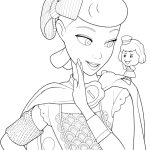

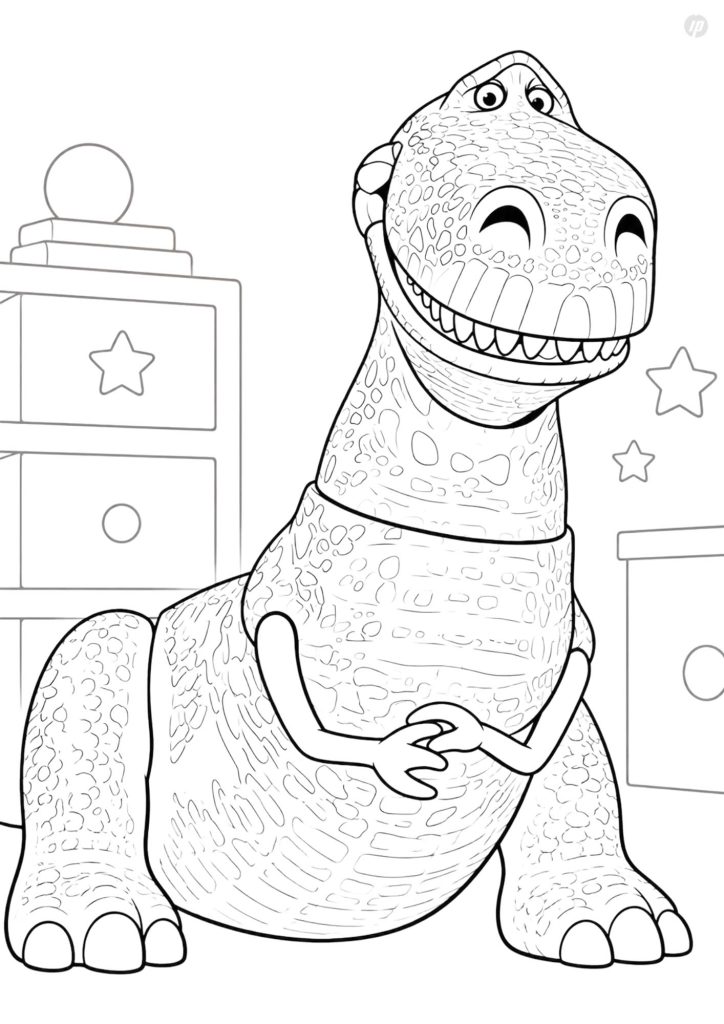
The funniest thing about Rex is not his roar. It is how fast a 12-inch plastic dinosaur can start worrying about absolutely everything. This printable Rex from Toy Story 5 coloring page captures the lovable T. rex with his chunky feet, tiny arms, wide mouth, and nervous personality ready for kids to color.
Rex may look like one of the most powerful dinosaurs ever, but being scary has never come naturally to him. Pixar describes him as neurotic and insecure, with limited arm movement and a roar that does not sound quite as fierce as he hopes. That mismatch has made him a favorite member of the Toy Story crew since the original movie. He wants to help his friends, yet even a small problem can send him into a burst of panic.
His design gives young artists plenty to work with. Rex is a hard plastic Tyrannosaurus toy with a long tail, thick legs, two-toed hands, three-toed feet, and rows of broad white teeth. His body is usually bright green, while his belly, lower jaw, and the front of his neck are a lighter yellow-green. Molded scales cover much of his surface, and visible joints separate his head, arms, legs, and tail from the main body.
Kids can begin with a green crayon or colored pencil and fill the larger areas using smooth, even strokes. A pale green or soft yellow works well across the belly. Leaving the teeth white creates the familiar Rex look, while pink, red, or dark burgundy can be used inside his mouth. The outlines around his joints act like natural borders, which can make the page easier for younger children to color without covering nearby sections.
The scale texture offers another way to personalize the picture. Instead of using one flat shade, children can draw small curved marks across the back and tail. Mixing light and dark greens can make the molded texture stand out. Markers are useful for the smaller details, crayons cover the broad body quickly, and washable paint can create a bold version when the page is printed on heavier paper.
Rex returns in Toy Story 5, with Wallace Shawn once again providing his original English voice. The movie places Woody, Buzz Lightyear, Jessie, Rex, and the other familiar toys in a world where children are giving more attention to electronic devices. A new tablet named Lilypad becomes part of that challenge. Rex fits this theme especially well because the franchise has already shown his interest in video games. At the beginning of Toy Story 2, he plays a game called Buzz Lightyear: Attack on Zurg.
That gaming connection can inspire a background without copying a scene from the movies. Kids might draw a controller beside Rex, create a pretend game screen behind him, or add a row of colorful buttons and arrows. The game could be about collecting batteries, finding lost toys, or helping Rex practice a bigger roar. Parents and teachers can ask children to name the game and write one sentence explaining how to win.
The drawing also works well for a simple two-color lesson. Choose two shades of green, then decide where the darker color changes into the lighter one. Older children can blend the shades together, while younger kids can keep each area separate. The scales may be filled with repeating patterns, such as green, yellow, green, yellow, turning part of the dinosaur into an easy pattern activity.
Printing a second copy opens up a completely different idea. One page can follow Rex’s classic colors, while the other becomes a custom toy design. He could have blue scales, orange spots, purple feet, or a bright racing stripe along his tail. Children can even draw a toy package around him and invent a funny feature for their new version, such as a button that plays game sounds or a roar meter that never reaches the top.
Once the coloring is finished, Rex can become part of a short storytelling activity. A child might explain what made him nervous, which toy helped him, and what happened after he finally pressed the start button. His worried face, dinosaur shape, and love of games give children plenty of real character details to build on while they color, draw, and create.
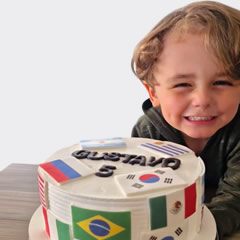
At just 5 years old, Gustavo turned a simple request to print coloring pages into an idea that now inspires children in more than 150 countries.
That is how Imprimivel.com was born, a project created alongside his father, Jean Bernardo, to spread color, imagination, and joy across 10 different languages, reaching a potential audience of more than 800 million children around the world.
Today, Gustavo is responsible for curating the content, enthusiastically choosing the themes and characters that will make other children smile, always under the editorial guidance of his father, who brings his son’s ideas to life.