
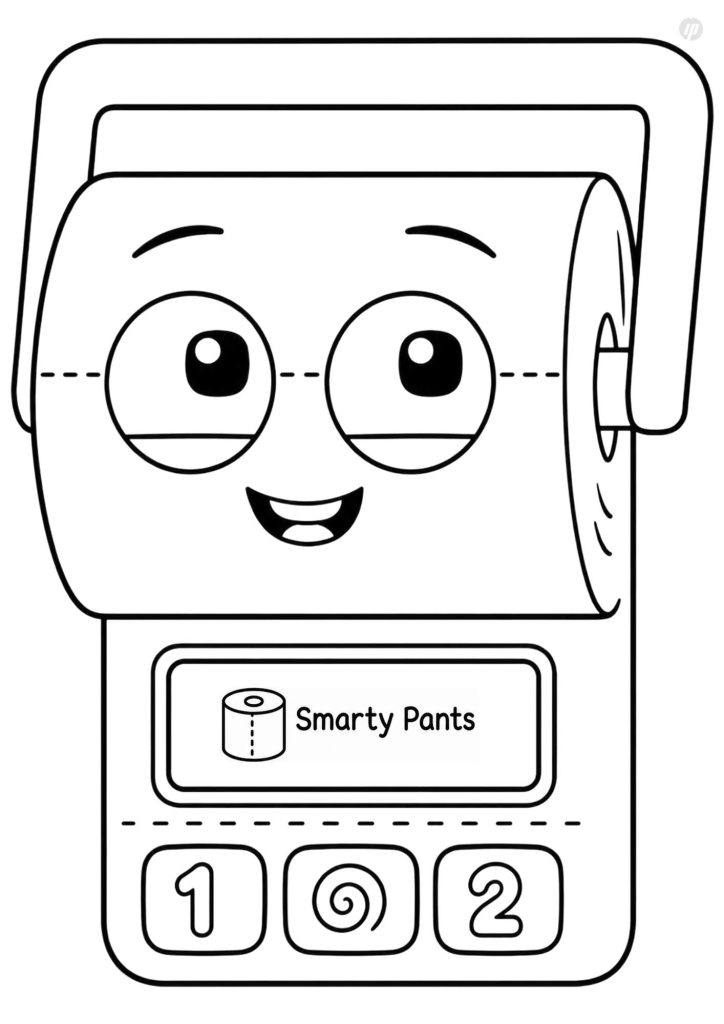
A roll of toilet paper with glowing green eyes suddenly wakes up, scans the room, and starts talking like he knows everything. That is Smarty Pants, one of the most unusual new toys in Toy Story 5. After spending years powered down and forgotten, this vintage potty-training gadget gets fresh batteries, a new mission, and another chance to show off his big personality. This Smarty Pants coloring page is ready to print for a creative activity at home, in the classroom, or during a Toy Story movie day.
Smarty Pants is easy to recognize because his face appears right on the toilet paper roll at the top of his body. His eyes, eyebrows, and mouth are made from chunky digital pixels rather than ordinary facial features. Under the roll sits a rounded electronic base with a small display screen and three visible controls. One side has a button labeled “1,” the opposite side has a button labeled “2,” and a blue control sits between them.
Kids who want to color Smarty Pants like he appears in the movie can start with an ivory or off-white shade for the paper roll. His main casing has a warm cream color, while the side support has a golden yellow look. The digital eyes glow green. On the front panel, the first numbered button appears yellow or amber, the center control is bright cyan blue, and the second numbered button is red.
The large sections of the body work well with crayons because they can be filled using broad, even strokes. Colored pencils are useful for the corners of the control panel and the smaller scratches on the casing. Fine-tip markers can make the numbers and pixel shapes stand out, especially when a spare sheet of paper is placed underneath to protect the table.
The small screen offers another detail to color. In one official image, it displays the words “SMARTY PANTS,” while other scenes show electronic symbols and changing graphics. Children can copy the name from the movie, draw a battery symbol, or design a new pixel face. A second printed copy can be used to try a completely different screen and color scheme without changing the first picture.
Before joining the story in Toy Story 5, Smarty Pants belonged to a child named Blaze. He was designed as a high-tech toy that helped with potty training. Once Blaze outgrew that stage, the device was no longer needed and spent years sitting in an old playhouse or toy shed in sleep mode. The worn spots, scuffs, and marks on his casing help show that he has been stored away for a long time.
Fresh batteries bring Smarty Pants back online when he is recruited for a mission. He returns with plenty to say. Pixar describes him as a wisecracking know-it-all with a bold attitude, which matches the meaning behind his name. In American English, “smarty-pants” is a playful expression for someone who acts like they always have the cleverest answer.
Conan O’Brien provides the original English voice for Smarty Pants. Director Andrew Stanton had been listening to O’Brien’s podcast and began connecting the comedian’s quick, sarcastic style with the character. Stanton even prepared a special pitch for the role. Before O’Brien joined the cast, Stanton recorded the temporary voice used by the production team while scenes were still being developed.
Smarty Pants did not always look like a toilet paper roll. Production designer Bob Pauley revealed that an early idea shaped the character like a pair of pants. The filmmakers found that version too limited for the amount of acting and expression needed in a feature-length movie. A new direction began with a sketch created by an intern named Naomi, combining the roll with an electronic base. The Pixar team then refined that design into the character seen on screen.
His pixel face was carefully planned too. The artists researched screen technology from the 1980s, 1990s, and early 2000s because Smarty Pants was meant to look older than the newer electronic toys in the movie. His display refreshes more slowly, and the pixels are large enough to see clearly. Those limits became part of his personality because every eye movement, eyebrow angle, and mouth shape has to work within the old-fashioned screen.
That visual style creates a useful drawing activity. Children can build expressions from tiny squares, almost like making a picture on graph paper. High eyebrows can make Smarty Pants look surprised. Slanted brows can give him a suspicious look. A wide row of pixels can become a grin. This can also work as a classroom exercise about how simple shapes communicate different emotions.
Jessie and Bullseye encounter Smarty Pants on Blaze’s property and help bring him back into the action. An official Disney image also shows Jessie beside him. Kids who enjoy adding backgrounds can draw the old playhouse, storage boxes, shelves, or a few fresh batteries near the character. Jessie can be added to the scene, along with Atlas and Snappy, two other technology-based toys that appear with Smarty Pants in the movie.
The numbered controls can become part of a matching or counting activity after the coloring is finished. Younger children can trace the “1” and “2,” while older kids can design extra symbols for the screen. Families or classmates can print several copies and compare how different colors and pixel expressions change the same character.
With his paper-roll face, retro display, colorful controls, and slightly worn casing, Smarty Pants has plenty of details to paint, color, and draw. His design also tells part of his story before he even speaks: he is an older gadget that has been switched off for years, but one set of new batteries is enough to bring his clever expressions and confident voice back to life.
At just 5 years old, Gustavo turned a simple request to print coloring pages into an idea that now inspires children in more than 150 countries.
That is how Imprimivel.com was born, a project created alongside his father, Jean Bernardo, to spread color, imagination, and joy across 10 different languages, reaching a potential audience of more than 800 million children around the world.
Today, Gustavo is responsible for curating the content, enthusiastically choosing the themes and characters that will make other children smile, always under the editorial guidance of his father, who brings his son’s ideas to life.
Other similar drawings
Lilypad
Woody
Buzz Lightyear
Jessie
Forky
Boonie
Hamm
Slinky
Rex
Combat Carl
Hiccup
Snotlout
Gobber
Tuffnut
Meatlug
Hookfang
Chief Bogo
Judy Hopps
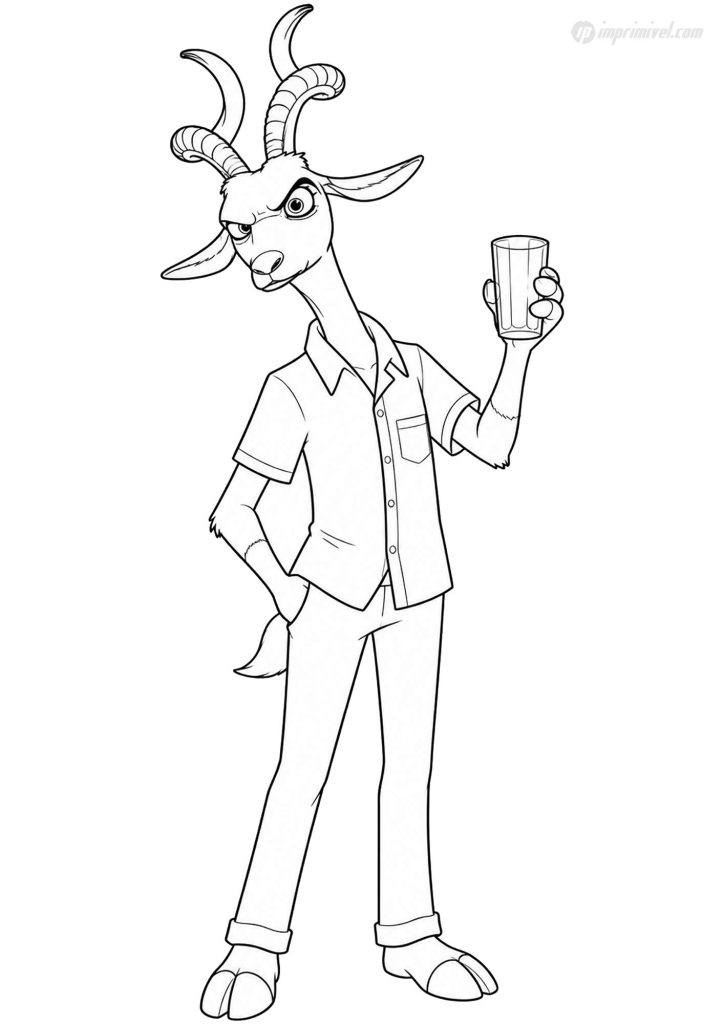
Gazelle
Sloth
Nibbles Maplestick
Fru Fru
Gideon Grey
Nangi
Officer McHorn
Dr Madge Honey Badger
Mouse Foreman
Jaguar
Pronk Oryx-Antlerson