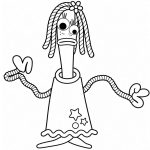

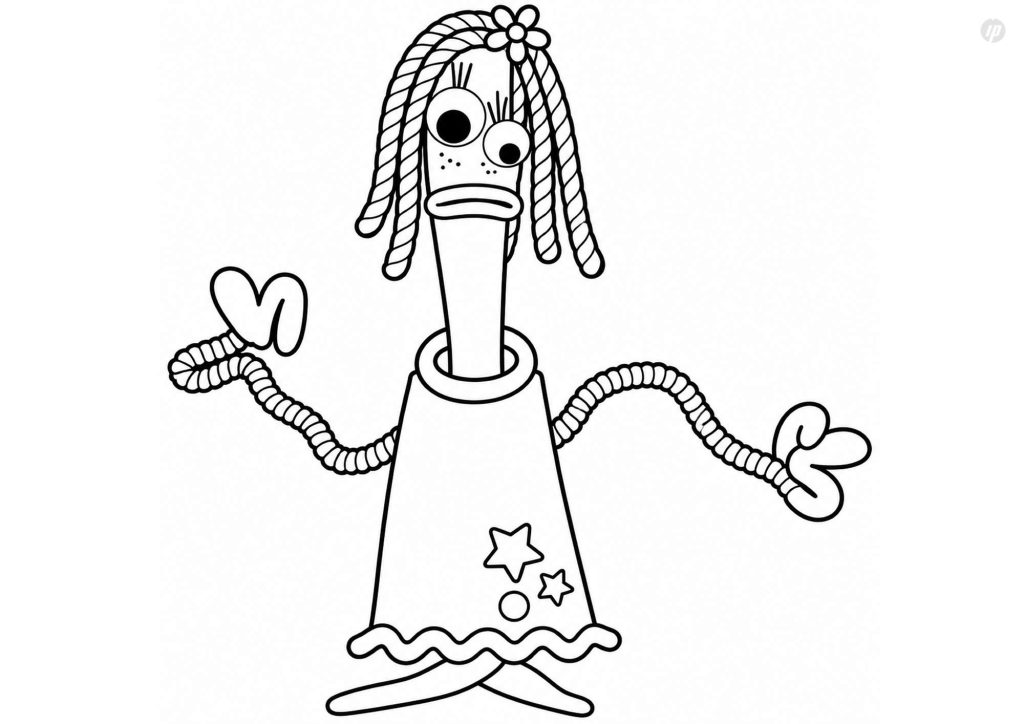
Who shows up for one of the cutest weddings in the Toy Story world wearing a handmade outfit and starting life as a plastic knife? Karen Beverly, of course. In Toy Story 5, this wonderfully unusual toy gets a very special moment with Forky as the two get married inside Bonnie’s world of play. Karen may look like something that came straight from an afternoon craft table, but that is exactly what makes her so fun to color. Her mismatched shapes, homemade decorations, funny eyes, bright outfit, and tiny details give kids plenty of room to choose colors, try new ideas, and turn every printed Karen Beverly coloring page into something completely different.
Karen Beverly fits right into the part of Toy Story that kids understand almost instantly: nearly anything can become a character once imagination takes over. She is not a shiny action figure that arrived in a box or a fancy electronic toy with buttons and sounds. She began as an ordinary plastic knife and became one of Bonnie’s handmade toys. In Toy Story 5, Pixar describes Karen as still figuring out the world, trash, and what being a toy actually means. There is one thing she seems pretty sure about, though. She loves Forky, and she is very excited about her wedding outfit. That gives this quirky little character a sweet personality before a child even picks up the first crayon.
That wedding idea gives kids a bunch of fun ways to approach a Karen Beverly coloring page. Maybe her outfit stays close to the movie version. Maybe it gets completely redesigned. A child could color her dress purple with bright pink decorations, make the little details sparkle with yellow and orange, or imagine that Bonnie made her a whole new outfit for another pretend celebration. There is no need for every picture to match what appears on screen. Coloring is often more fun when kids get to decide what the character would look like in their own version of the story.
Karen is especially fun to paint or color because her design already has the playful feeling of a kid made craft. Her body is built around a plastic utensil, while the decorations around her make her look as though Bonnie grabbed whatever fun supplies were nearby and started creating. When children look closely at a Karen Beverly drawing, they can notice how many different shapes make up one character. There are rounded eyes, thin arms, pieces that resemble paper or craft materials, hair, decorations, and clothing. Instead of filling one giant area with the same color, kids can bounce from detail to detail and switch crayons whenever they feel like it.
Parents can also turn the coloring session into a tiny imagination game without making it feel like homework. Ask something silly like, “What do you think Karen would wear to a second party?” or “If Bonnie gave her a new hat, what would it look like?” A child may decide she needs a giant purple crown, rainbow shoes, star covered clothes, or a totally new hairstyle. Then they can draw those ideas around the original picture. One simple printable can suddenly turn into a much bigger scene.
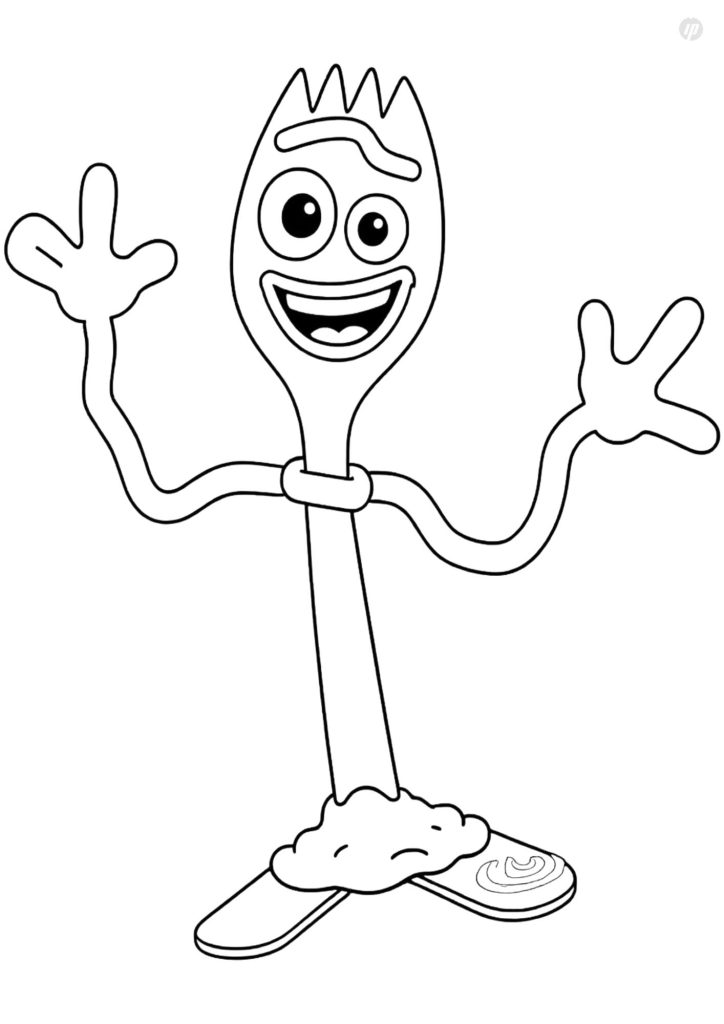
Forky naturally belongs in that conversation too. Karen Beverly and Forky make an especially funny pair because both characters come from everyday items that became toys through Bonnie’s creativity. Forky is a spork, Karen is a plastic knife, and together they look nothing like the traditional toys that fill Bonnie’s room. Toy Story 5 takes that connection even further by giving the pair a wedding. Pixar describes Forky as teaching Karen what he has learned about being a toy, life, and trash, which is pretty funny considering how confused Forky himself once was about all of those things.
Kids who remember Forky from Toy Story 4 may get an extra laugh out of that idea. Forky spent a lot of time trying to understand why everyone kept calling him a toy when he was convinced he belonged somewhere else. Karen arrives with her own questions about being alive and being part of the toy world. That makes her feel like a natural match for him. They are both odd, handmade, lovable creations that do not look like anybody else in the room.
A Karen Beverly printable also works really well for kids who enjoy characters with lots of small decorative areas. Some children race through big open spaces with a crayon, while others can sit forever deciding what color one tiny star should be. Karen lets them do both. Her basic body is simple enough for younger kids, yet the craft inspired parts offer extra little spaces for older children who enjoy paying attention to details.
Crayons are an easy choice, especially if the coloring page is being printed for younger kids. Colored pencils can be handy for smaller parts around Karen’s face and decorations. Washable markers can make the colors look bold, especially if a child wants the wedding outfit to really pop. Kids who enjoy painting can even use a printed page as inspiration for a separate painting, copying Karen onto another sheet or drawing their own version first.
There is also no rule saying Karen has to appear by herself. After coloring her, children can draw Forky standing next to her. They might add Jessie, Buzz Lightyear, Woody, or some of Bonnie’s other toys in the background. A wedding scene could include balloons, flowers, stars, confetti, presents, or decorations that never appeared in the movie at all. One kid might draw a giant cake. Another might decide the ceremony needs a toy dinosaur as a guest. Somebody else may fill the page with hearts. Those little choices are what make a printable feel less like a picture that needs to be finished and more like the beginning of a story.
The handmade look of Karen Beverly also makes her a neat character for classrooms, playrooms, or family craft time. After kids color the page, an adult can invite them to design a brand new Toy Story style character on another sheet of paper. What ordinary object would they start with? A spoon? A paper cup? A cardboard tube? A button? They can draw eyes, arms, clothes, hair, or whatever weird accessories come to mind. The goal does not have to be creating something perfect. In fact, characters like Karen and Forky are charming partly because they look handmade.
This is one reason Karen feels so at home in Bonnie’s Toy Story world. Pixar has explained that Toy Story 5 explores Bonnie’s imagination with a handmade arts and crafts feeling, giving her imagined play a style that reflects the way she creates. Karen Beverly fits naturally into that visual world because she already looks like something Bonnie could have assembled herself during craft time.
That idea can give parents and teachers an easy way to connect art with storytelling. A child can color Karen first, then make up one sentence about where she is going. Maybe she is getting ready for her wedding. Maybe she and Forky are looking for the rest of the toys. Maybe she is trying on another outfit. Maybe she has decided she wants to become the fanciest plastic knife in the entire toy box. There does not need to be a right answer. The fun part is letting the drawing start the story.
For younger children, even choosing colors can become part of the conversation. An adult can ask which crayon should come next, where a certain color might look good, or what Karen’s favorite color might be. Older kids may enjoy trying patterns instead. They can add dots to the dress, stripes to an accessory, tiny stars around the background, or a repeating rainbow design. Those choices let children practice controlling pencils and crayons while staying focused on something they actually enjoy.
Fans of Toy Story 5 may also recognize that Karen belongs to a movie where play itself becomes a big part of the story. The main toys face Lilypad, a new tablet that changes how Bonnie spends her time and challenges the place that traditional toys have in her life. Karen stands on the opposite end of that idea in a pretty charming way. She is about as handmade as a toy can get. Her whole existence comes from a child turning ordinary materials into a character. That makes her a fun choice for a coloring activity because the activity itself depends on the same kind of imagination.
A blank coloring page does not do much until somebody decides what belongs on it. Karen Beverly started as something ordinary too. Bonnie’s creativity turned a plastic knife into a toy with a face, clothes, personality, and a place beside Forky. A child holding a box of crayons gets a similar little chance to transform something plain. The black and white lines are already there, but everything else is open.
Some kids may want their Karen Beverly coloring page to look as close to the movie as possible. They can study her outfit and try to match the familiar colors. Other kids will immediately ignore every original color and invent their own. Both ways work. Coloring does not need to become a test of how accurately somebody remembers a character. If Karen ends up with rainbow hair and a bright blue wedding outfit, she is still Karen.
Printing more than one Karen Beverly coloring page can make that even more obvious. One copy can follow her movie look while another becomes a wild redesign. Siblings can color the same drawing differently and compare their versions. Friends can each make a Karen for the same pretend wedding. A teacher can print several copies and end up with a whole wall of Karen Beverlys where no two look alike.
Children who like to draw can use the printed character as a reference too. Her unusual shape makes her an interesting character to recreate because she is built from recognizable craft materials rather than a complicated human body. Kids can start with the basic knife shape, add the eyes, sketch the arms, create clothing, and then invent the decorations themselves. The result does not have to match Pixar’s design exactly. Drawing her from memory can be even funnier because all kinds of unexpected details may appear.
There is another playful challenge hiding in Karen’s design: what would a child change if Bonnie made her again today? Maybe she would get different hair. Maybe her clothes would be made from another kind of paper. Maybe she would have three stars instead of two, a giant bow, or boots drawn directly onto her feet. Asking that question while kids color can lead to completely new drawings once the first page is finished.
Karen Beverly also works nicely for quiet time because there is enough detail to hold attention without making the picture feel overwhelming. A printable can come out during a rainy afternoon, after school, at a Toy Story themed birthday party, during classroom free time, or whenever somebody wants an activity that does not involve staring at another screen. Put a few crayons or colored pencils on the table and let the page take it from there.
Parents looking for Toy Story 5 coloring pages can pair Karen with Forky for an especially cute combination. Kids can color the two characters separately and then place the finished pages next to each other. They can also draw a background that connects both pictures, turning them into one giant pretend wedding scene. Add Jessie as a guest, Buzz standing nearby, or Woody arriving just in time for the celebration. The actual page gives children a starting point, while the empty spaces around it are theirs to fill.
Karen Beverly may be made from a humble plastic knife, but that simple idea is a big part of her charm. She reminds kids that a toy character does not need flashing lights or complicated gadgets to inspire a story. Sometimes a funny face, a few craft supplies, and a kid with a good idea are plenty.
Pick your favorite Karen Beverly coloring page, print it out, and grab whatever colors sound fun today. Paint her outfit with unexpected combinations, draw extra decorations around her, give Forky a spot beside her, or invent a brand new scene from Bonnie’s imagination. Karen already began life as a homemade creation, so changing things up feels perfectly right for her. Every new color gives this quirky Toy Story 5 character one more handmade look that belongs only to the kid who created it.
At just 5 years old, Gustavo turned a simple request to print coloring pages into an idea that now inspires children in more than 150 countries.
That is how Imprimivel.com was born, a project created alongside his father, Jean Bernardo, to spread color, imagination, and joy across 10 different languages, reaching a potential audience of more than 800 million children around the world.
Today, Gustavo is responsible for curating the content, enthusiastically choosing the themes and characters that will make other children smile, always under the editorial guidance of his father, who brings his son’s ideas to life.