
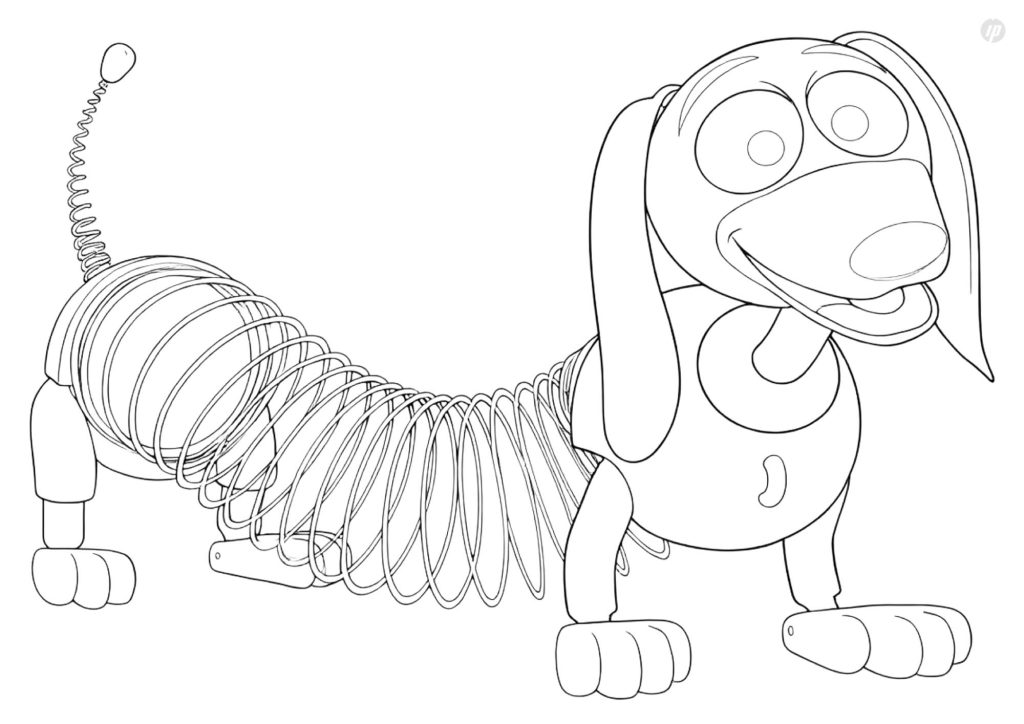
His front paws are ready to roll, his back paws are still catching up, and a long metal spring stretches right through the middle. There is no mistaking Slinky Dog! This Toy Story 5 Slinky Dog coloring page is ready to print, color, and turn into a playful art activity built around one of the most recognizable toys in the Pixar series.
Slinky, often called Slink by his friends, is shaped like a dachshund, the long-bodied dog many American kids know as a wiener dog. Instead of having a regular belly, he has a flexible metal coil connecting the front and back halves of his body. His classic design also includes floppy dark brown ears, a round black nose, a bright green collar, short legs, and tiny wheels beneath his paws.
Those details give kids several textures to work with on the same printable page. Warm tan, caramel, or orange-brown pencils match his familiar plastic body. A deeper brown works well for the soft-looking ears and paws, while green makes the collar pop near his face. The spring can be colored silver, light gray, or even pale blue to create the look of shiny metal.
Slinky has been part of the Toy Story group since the original movie. Pixar describes him as Woody’s trusted friend and checkers partner, while Disney calls him a sensible, practical pup who will stretch a long way to help someone. His calm attitude and loyalty make him a dependable member of the toy box crew, especially when the group needs teamwork instead of flashy gadgets.
His unusual body also comes in handy. Across the Toy Story movies, Slinky can reach places other toys cannot, cross spaces, pull friends, and use his spring when a problem calls for extra length. He may be funny to watch as his two halves roll in different directions, but the joke never gets in the way of his most important quality: he sticks with his friends.
In Toy Story 5, Slinky Dog returns alongside Woody, Buzz Lightyear, Jessie, Rex, Hamm, and the rest of Bonnie’s toys. This time, their familiar kind of play faces a high-tech challenge when Bonnie becomes fascinated by Lilypad, a tablet device with ideas of her own. A classic pull toy with wheels and a metal spring fits naturally into a story about what happens when traditional toys meet screen time.
The coil is the most interesting part to color carefully. Younger children can follow each curved line with a thick crayon, while older kids can alternate light and dark gray between the loops. That small change creates depth and makes the spring look rounded. Colored pencils are helpful around the narrow spaces, and washable markers can add bold color to the larger sections of his head and body.
Kids can also use the page for a simple line-control activity. Start at one end of the spring and trace each curve without jumping across the loops. Another idea is to count how many coils appear in the drawing, then add more with a pencil. Repeating those rounded shapes gives little hands practice with smooth, controlled movements.
Slinky Dog was inspired by a real American pull toy that existed decades before Toy Story. The original Slinky was invented during the 1940s, and a patent for a dog-shaped version followed in 1957. In the early 1990s, an agreement allowed Slinky Dog to become part of Pixar’s first Toy Story movie, released in 1995. The old-fashioned toy gained an entirely new personality on screen while keeping its famous spring body.
There is also a neat connection between Slinky’s voices across the films. Jim Varney voiced him in the original Toy Story and Toy Story 2. Blake Clark later took over the role and returned as Slinky Dog in Toy Story 5, helping the character keep his familiar easygoing sound for a new chapter of the series.
After coloring the character, children can draw the rest of the scene around him. His spring might stretch from a toy chest to a stack of blocks, connect two sides of Bonnie’s room, or help another toy reach a high shelf. These additions can be clearly treated as the child’s own story rather than a scene from the movie.
A second printed copy makes room for a completely different design. One version can use Slinky’s movie colors, while another can give him rainbow coils, patterned ears, or a collar in a favorite color. Crayons work well for a soft finish, colored pencils make the small details easier to control, and a thin brush with washable paint can cover the wide body sections.
Once the coloring page is complete, try following Slinky from his nose to the tip of his tail without lifting a finger from the paper. His extra-long shape turns a familiar Toy Story character into a fun mix of coloring, tracing, counting, and drawing.
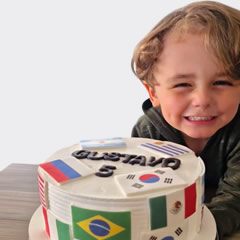
At just 5 years old, Gustavo turned a simple request to print coloring pages into an idea that now inspires children in more than 150 countries.
That is how Imprimivel.com was born, a project created alongside his father, Jean Bernardo, to spread color, imagination, and joy across 10 different languages, reaching a potential audience of more than 800 million children around the world.
Today, Gustavo is responsible for curating the content, enthusiastically choosing the themes and characters that will make other children smile, always under the editorial guidance of his father, who brings his son’s ideas to life.